
Georgia Corrections Release Records
GDC records apply when a Talbot County case resulted in state imprisonment, a transfer to state custody, release from a state prison, or parole-related review. A county jail entry that says “released to GDC” is a transfer, not a community discharge. The state record may show a GDC identifier, demographic descriptors, current status, facility or release information, sentence and offense data, parole links, and an offender photograph when available.
The sheriff's booking and release record is the best source for the local custody event. A court docket explains the legal cause, such as a bond order, dismissal, sentence, probation order, or revocation. If the notation says GDC transfer, use the statewide offender search next. Federal and immigration transfers belong in separate federal systems. These records answer different questions and should be read together.
The official GDC offender query shown below is the statewide search form.
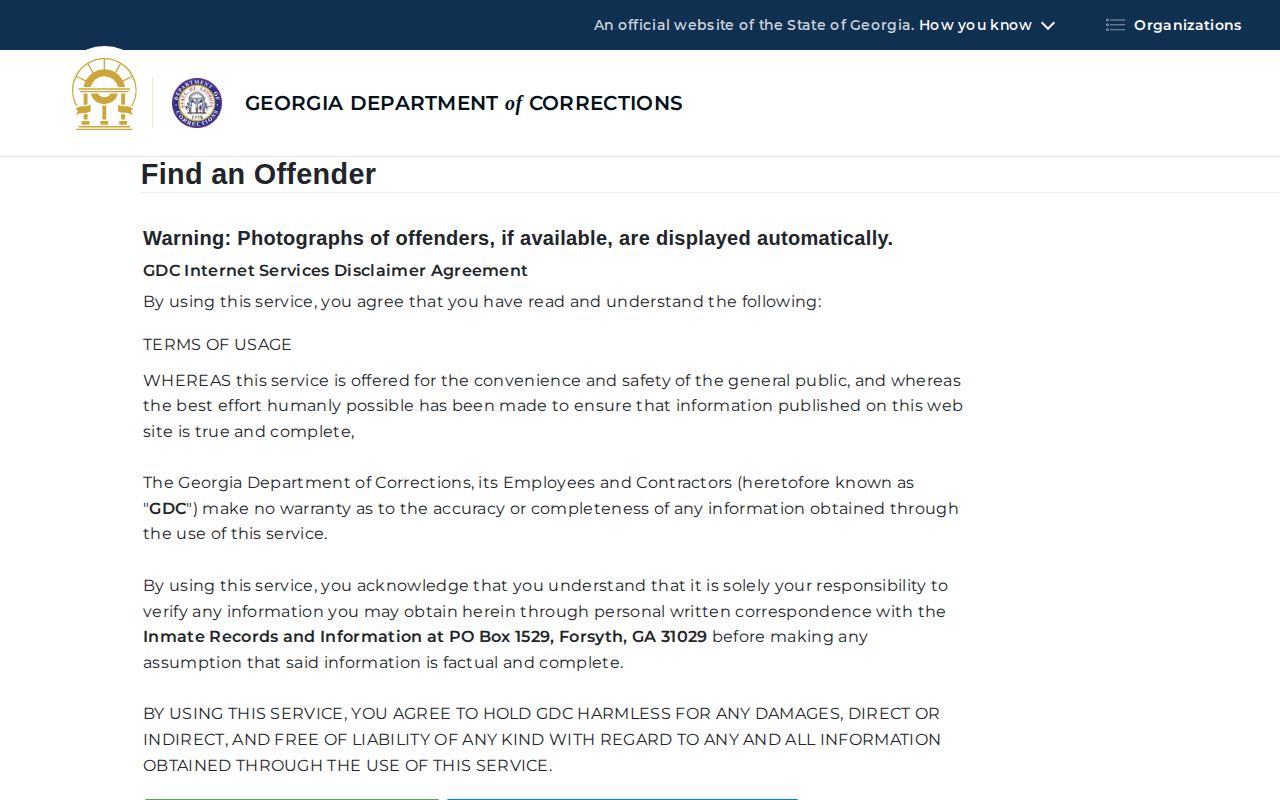
The form is a state-prison search and should not be read as a live Talbot County jail roster.
Search GDC Talbot Release Status
Open the GDC Find an Offender page and continue to the query form. Search by GDC ID or case number when known because an identifier narrows false matches. Otherwise use last name and first name, then compare age, sex, race, and case details. Open the matching result and copy the exact status, facility, sentence, offense, and release-related labels.
- Call the sheriff at 706-665-3111 for current local status.
- Search Georgia VINELink for the specific person and agency.
- Check the clerk's docket or calendar for the bond or disposition behind the change.
- If the jail reports a state transfer, search the GDC offender query.
- Request the existing booking and release record when written proof is needed.
The full Talbot County released-inmate search path explains how those systems fit together. A missing VINELink result does not prove release because agency participation and update timing can vary.
GDC Records Request Contact
Use the GDC open-records portal for state corrections material not displayed in the public result. GDC location pages identify the central mailing address as 300 Patrol Road, Forsyth, GA 31029, and list 404-656-4661 for inmate concerns and questions.
300 Patrol Road
Forsyth, GA 31029
Inmate questions: 404-656-4661
Online open-records portal available
Identify the offender by full name, GDC ID or case number, and the state record sought. GDC states that it gives an initial response within three business days. Non-medical copies cost ten cents per page, while search and redaction may be billed at the hourly rate of the lowest-paid qualified employee. Ask for a cost estimate when the scope may require staff time. These are GDC terms and do not establish a Talbot County sheriff fee.
About Georgia Corrections Records
GDC operates the statewide corrections record system for people in its facilities and people with state offender records. It does not operate the live Talbot County Jail roster. A person arrested locally may never appear in GDC if the charge is dismissed, the person posts bond, remains pretrial, or receives only a local disposition. GDC becomes relevant after a state commitment, state imprisonment, state release, or parole path.
A person arrested locally may never enter GDC records. A case may end through bond, dismissal, a local sentence, or another court result. By contrast, someone sentenced to state imprisonment may leave the county jail through a transfer and then appear in GDC custody. Court records remain useful in either path because they preserve the bond, sentence, or disposition that explains why local custody ended.
Talbot Jail Court Release Orders
The Talbot County Superior Court handles felony criminal matters, while Magistrate Court may hold first appearances, bond proceedings, and preliminary matters. A jail status change alone does not state what happened to the case. The clerk record can show bond terms, dismissal, probation, sentence credit, revocation, or a transfer order. Court calendars include criminal calendar calls, bond hearings, arraignments, and trial settings, but a calendar date is not proof that someone is physically in jail.
For an official copy, contact the correct clerk. Superior and Juvenile records are handled at One Courthouse Square, P.O. Box 325, Talbotton, with phone 706-665-3239. Magistrate Court is at 26 South Washington Avenue and can be reached at 706-665-3595 during its posted weekday hours. Pair the order with the sheriff release record for a sound account of both legal status and physical custody.
Talbot Jail State Transfers
A county jail notation of “released to GDC” means the person changed custodians. Search GDC by GDC ID or case number when possible, or by name with age and other identifying details. Open the matching result and copy the exact status, facility, sentence, and release-related fields. Do not turn a Tentative Parole Month into a fixed release day. The Parole Board says TPM is a planning point for final review, not a final parole decision.
For state documents not visible online, use the GDC open-records portal. GDC states that it provides an initial response within three business days, charges ten cents per page for non-medical copies, and may bill search or redaction at the lowest-paid qualified employee's hourly rate. Those published GDC charges do not establish Talbot sheriff fees.
Talbot Jail Federal Holds
A federal or ICE hold changes the release destination. The BOP locator covers federal inmates from 1982 forward, and a past release date with no listed facility means release from BOP custody, not necessarily release from every justice system. ICE's locator is for adults currently in ICE custody or held by CBP for more than 48 hours. The U.S. Marshals Service manages many federal pretrial detainees until acquittal or commitment to BOP.
Ask the sheriff whether the local discharge was to a named agency. Then use that agency's locator. Neither a BOP nor ICE result proves an ordinary Talbot County Jail release unless the local record documents the transfer. Written release and transfer fields prevent a mistaken assumption that the person returned to the community.
Read Talbot Jail Release Records
A complete local record may include identifying data, booking date, charges, bond status, release date and time, release reason, and destination. Not every record uses the same labels. Copy the agency's wording rather than changing a transfer into a community release. “Time served” means the court credited the term as complete. “Nolle prossed” means the prosecutor declined to proceed on a charge at that point. “Detainer” means another agency asked the jail to keep or transfer the person. None of those labels alone supplies the full court history.
Compare names with care. Include a date of birth, case number, or booking date when the name is common. The jail record is a custody-event record, not a full criminal-history report. It answers whether the sheriff booked, held, released, or transferred the person. The court file answers what happened to the charge. GDC answers state-prison status. Parole and DCS sources answer post-release supervision questions. Keeping those roles separate makes a Talbot County Jail release record far easier to read.
If a date, identity field, or transfer notation appears wrong, contact the office that created that record. The sheriff handles the local booking and release entry. The clerk handles its docket and orders. GDC handles state corrections data, and the Parole Board or DCS handles its own parole or supervision data. Talbot County has no verified self-service edit portal for these records, so a focused written request that identifies the disputed field and supplies supporting documents is the practical correction route.
Talbot Jail Release Follow-Up
After confirmation, decide which fact still needs proof. For physical custody, obtain the sheriff's release or transfer entry. For the legal cause, obtain the filed court order or docket. For state custody, preserve the exact GDC status and contact GDC records if the public result is incomplete. For parole, distinguish a current parolee entry from a TPM for someone who is still imprisoned. VINELink is useful for a status alert, but it does not replace any of those originating records.
Release information can change quickly. A bond can be posted, a hold can clear, a new detainer can arrive, or an agency can complete a transfer after an initial phone call. Record the time and source of each check. If the question matters to a court process or family plan, request the official record rather than depending only on an oral status report. That short audit trail shows which agency supplied each fact and avoids mixing local jail release with state, federal, or immigration custody.